Harvard Hit Us Up They Said Come to Art School
1st University-wide Harvard Staff Art Show celebrates employees' whole selves
Harvard'southward Common Spaces hosted a huge crowd — most 400 people — for the launch last month of the first Academy-wide Harvard Staff Art Show. The venue was, like most everything these days, virtual. But that format came with a bonus: Unlike concluding twelvemonth's Smith Campus Centre Staff Art Bear witness, which restricted the creative person pool because of limited wall space, this year's testify accepted submissions from all Harvard staff, featuring more than 280 artworks by 167 artists.
"There are and then many people at Harvard who you lot work next to," said Brianne Sullivan, an authoritative banana for Common Spaces, which helped organize the show, and an artist herself. "Yous run across them walk into the role side by side to you every day for years and years and years, and you lot don't know that they used to brand pillows or they do watercolors."
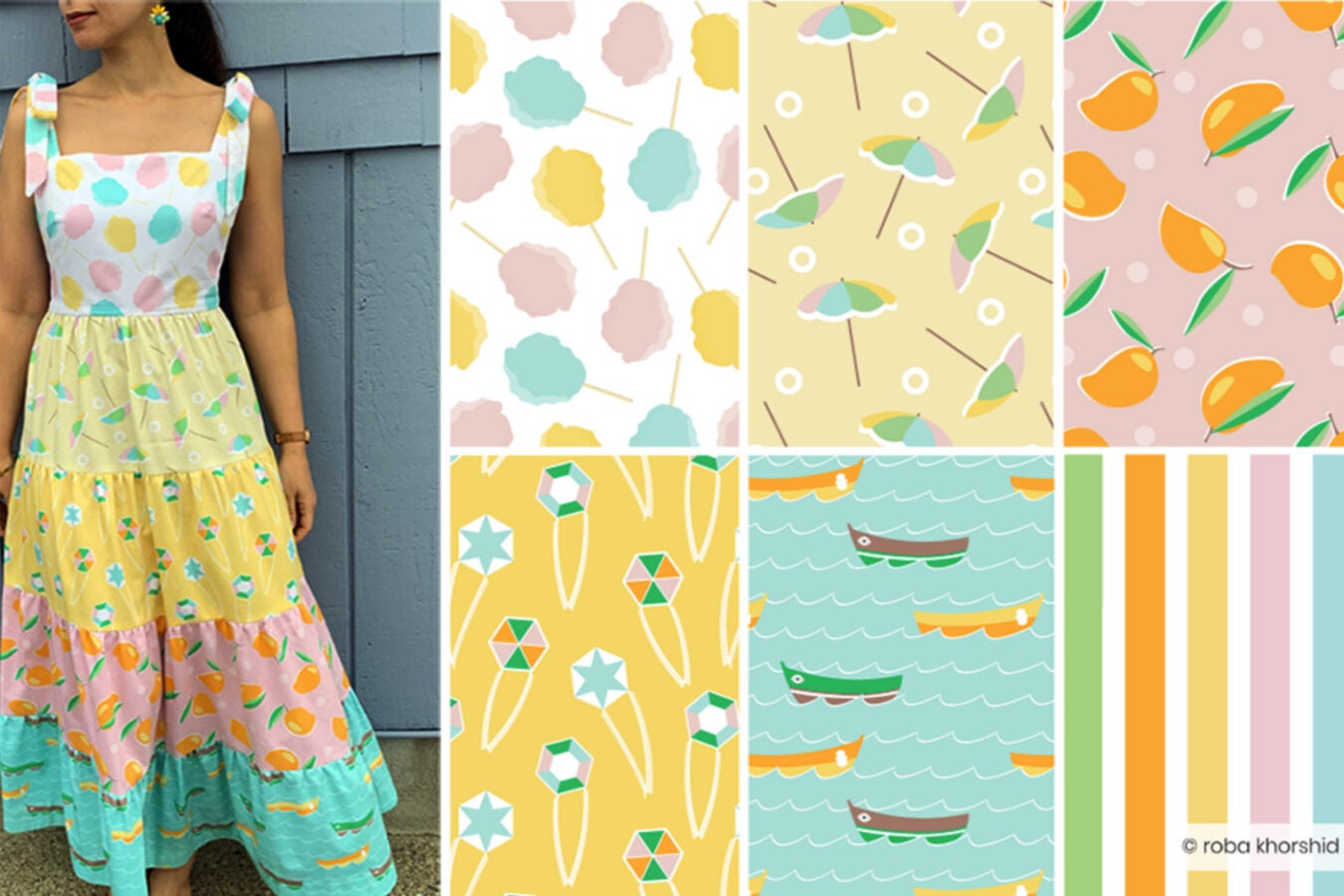
"Egyptian Summertime" by Roba Khorshid, who is an events coordinator in the Part of the Senior Vice Provost for Faculty Development and Diversity and a fashion designer.
These days, walking into a co-worker's role is an choice only for essential staff who are properly masked. Just even pre-pandemic, some people already worked in isolation — at Dumbarton Oaks, an fine art museum in Washington, D.C., and Villa I Tatti in Italy, for example. Mia Metivier, a program coordinator for the Harvard College Program in Full general Instruction and a painter and illustrator featured in the evidence, said, "This year, when we're all more removed from each other than ever before, there's an even greater need to create spaces to connect and engage with each other every bit 'whole selves'" — what the show'south mission argument defines every bit "the artistic, creative sides that may not otherwise be a part of our work at Harvard."
Or, as Sullivan put information technology, "We're so much more than than our day job."
Roba Khorshid, an events coordinator in the Role of the Senior Vice Provost for Kinesthesia Development and Diversity and a mode designer, said that despite the diversity and number of submissions, she noticed a few mutual trends in the artwork: pets and lawn wild animals, trees both shadowy and bursting with colour, flowers of paper, paint, wool, or existent life, waterways and mountains, and portraits.
Several pieces address social movements and injustices: a leaf emblazoned with the colors of the pride flag; a video titled "Black Lives Matter" that documents experiences with racism; and a painting called "United states of america," which features immigrant faces looking out from behind the carmine stripes of an American flag.
Another binding theme, not surprisingly, was COVID-nineteen. Two artists made their own masks: Marysara Naczi titled hers, "Don we at present our plague wearing apparel," and Emily Ronald designed fabric versions of archaic plague doctor masks. In an acrylic painting titled "2020" by Maynor Campos, masked patrons visit a colorful Guatemalan marketplace. Despite the brilliant feel of the piece, the face masks and wan expressions evidence how "our lifestyle has been drastically changed," wrote Campos in the description. And Mari Megias' ink drawing "Pandemic" is a drove of floating faces, their mouths afraid. "Pandemic rages," Megias wrote in her caption. "We scream silently. Terror-laden yet empty eyes. But we are all continued."
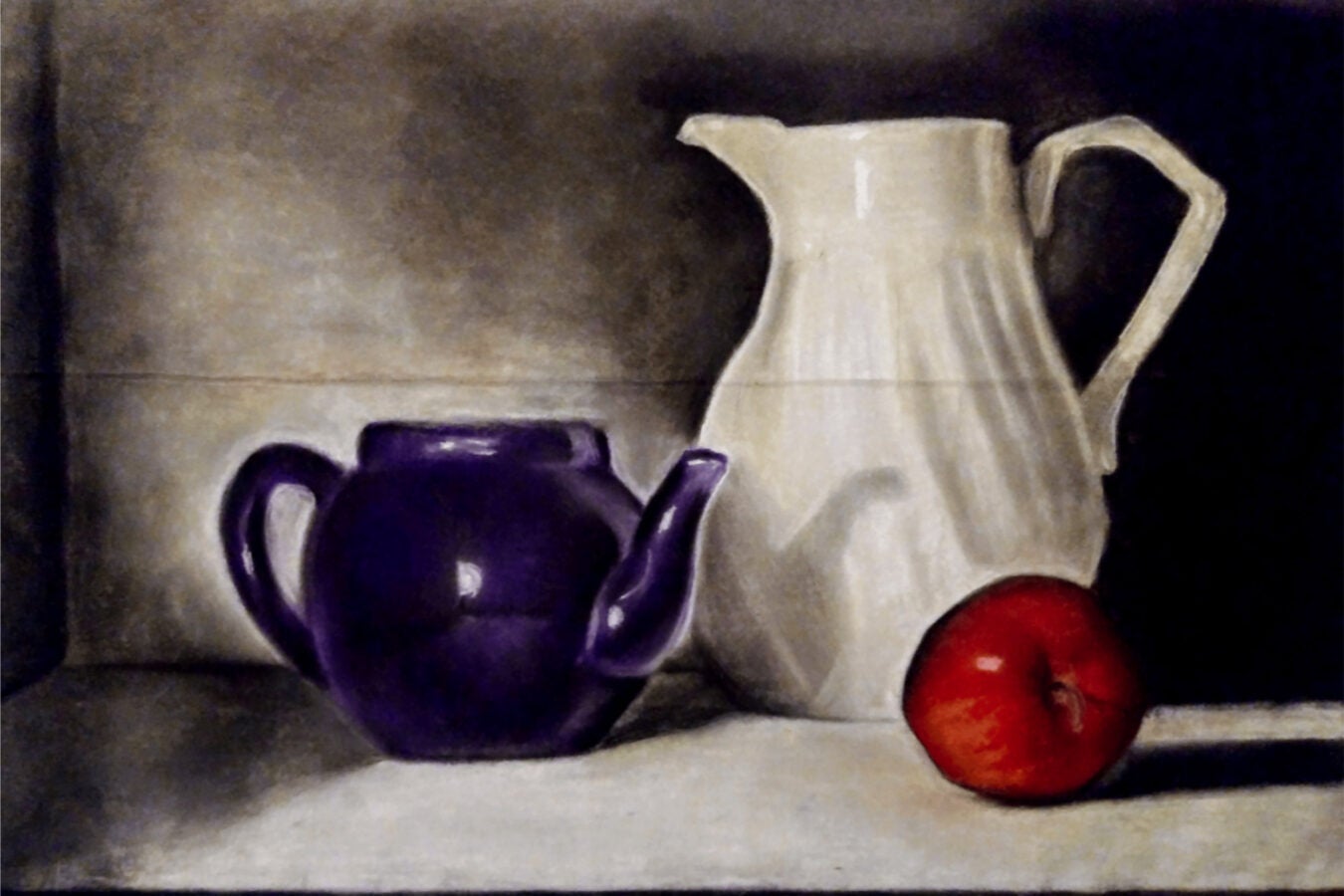
"This year ... at that place's an even greater demand to create spaces to connect and engage with each other equally 'whole selves,'" said Mia Metivier, who is a program coordinator at the College and an illustrator.
The massive 2021 virtual show was organized and run by nineteen volunteers, many of whom were as well participating artists. Khorshid, Metivier, and Sullivan all helped organize both this yr's evidence and last year's Smith Campus Center Staff Fine art Show. Together, the committee nerveless the hundreds of paintings, sculptures, photographs, animations, documentaries, musical performances, textiles, and more into a virtual gallery space. Metivier besides labored to make the virtual works accessible to all who nourish the launch or visit the online gallery space past adding descriptive alternative text, closed captioning, and transcripts to all visual and video submissions.
The steering committee selected three of the artists to requite short talks about their work earlier breaking into eleven medium-specific breakout rooms for more intimate conversations with artists. Those who preferred to stay in the primary session participated in a docent talk. Volunteers similar Metivier picked multiple pieces — including Desiree Guererro'south "WFH," a miniature replication of her at-dwelling house work space — to discuss in detail with guests. I guest noted that the wallpaper in "WFH" looked like bars, "a beautiful prison." "Our globe has gotten smaller," another said. Art, Metivier said, can exist a vehicle to express sorrows or fears without feeling too exposed.
Mayhap the most memorable part of the launch was Securitas security officeholder Vincent Liu'south "trailer," a four-minute-long animation featuring more than 100 of the evidence'south pieces: In it, a lime-dark-green moth fluttered and launched from its page, a portrait of a young Black adult female morphed into 1 of an older white man, and baby Yoda swung a low-cal saber earlier a space send outburst out of the ground.
Since the pandemic started, Liu said, "We're well-nigh silhouettes of ourselves. We don't really see each other." Just, he continued, coming together around a shared cause like art is a reminder that our 2D selves are only temporary.
"In the pandemic," said Marla Allisan, a clinical social worker in CAMHS/HUHS for Harvard Law School, who participated in the prove, "ane of the things nosotros are robbed of is the experience of witnessing each other and feeling witnessed, of feeling seen and understood."
With the majority of staff working from dwelling, behind computer screens, and tucked inside impersonal Zoom boxes, it's even harder to maintain, allow alone create, connections with colleagues. Sharing art, Allisan said, gives staff a risk to repair the injury to our community. For her, the prove was a pocket-sized but powerful way for staff to be seen.
As the virtual launch wrapped upward — afterwards an hour and but a couple of small-scale technical snags — audience members asked for more time, and then the organizers reopened the breakout rooms for another half-hour.
"We weren't certain how information technology was going to plow out," said Khorshid. "And it was better than annihilation we could have imagined."
Marla Allisan
Clinical Social Worker, CAMHS/HUHS for Harvard Law School / Illustration and Collage
Marla Allisan never thought of herself as an Creative person with a capital "A." That title, she said, is reserved for Michelangelo.
"I like saying I'thousand a role-time exhibiting artist," she said. "Just I say it with great humility because I know in that location are many people who devote their lives to making fine art, who can wear that clarification with greater authority."
Five years ago, Allisan walked into the Centre East eating house in Cambridge's Central Square and asked if they wanted some art for their walls. "That's where I had my get-go 1-woman show," she said. To her surprise, people bought her work. Since then, she'southward had more than i-woman shows, one at the famous Politics & Prose Bookstore in Washington, D.C. Now, her work hangs on walls in Canada and Russia.
For the two pieces she submitted to the Harvard Staff Art Show, Allisan layered her fluid figures on colored papers. One piece — a figure with an arched dorsum, oral fissure ajar, and merely the ball of a foot touching the ground — was selected for a docent talk during the show'due south virtual launch. Allisan enjoyed hearing the vast impressions that figure left: of joy, ache, or pleasure.
While she missed the "tender" experience of showing her piece of work in a more intimate in-person show, Allisan appreciated the virtual opportunity to connect and be "seen." The show, she said, gave staff "a sense of deeper humanity, to not just come across ourselves through an achievement lens."

Kat Chávez
Public Programs Assistant, Harvard Graduate School of Blueprint / Mixed Media
When Kat Chávez was born, she had a lot of hair. "Thick eyebrows. A ton of pilus. Not your typical bald, hairless baby," she said. Her father, who is of Mexican descent, said she looked like Frida Kahlo and the clan stuck: Chávez grew up with the nickname "Katie Frida."
Now, the Brown University graduate, who started her position at the Harvard Graduate Schoolhouse of Design in Baronial 2020, has lived up to her nickname, at least in i sense: She's a professional creative person. Chávez rents her ain studio in Brooklyn, N.Y., where she's riding out the pandemic, and has been featured in 12 exhibitions, not including the Harvard Staff Art Prove. Since she's used to more-sectional shows, Chávez said the staff show's universal credence was "a really beautiful gesture of inclusiveness."
One of the pieces she submitted, called "Botánica Extraña," is one of eight woodcut prints made as office of a community-oriented herbal healing project. Working with three community members, she researched which herbal remedies could alleviate their particular physical, mental, or spiritual ailment. Then she collected those herbs to use in a multilayer piece: herbs were overlaid to create a silhouette, which Chávez then printed and traced on wood blocks before carving them out and printing once more. She likes to create "multiple translations" of her materials to get to know them, she said.
Chávez's second submission, "Mirabilis Jalapa," is, on the surface, a soft red bucolic scene. That "tender" presentation was intentional, Chávez said, just this piece has layers, too: The reddish dye she used, chosen cochineal, was harvested from insects that feed on the prickly pear cactus in Latin American countries. During the colonial period, painters in Europe used this dye in "magnificent paintings," but the Indigenous workers who harvested it were either exploited or enslaved. Chávez is fatigued to that disharmonize between beauty and violence and the imposition of European demands on Indigenous culture. Above her painted scene, she embroidered the plant Mirabilis jalapa (the marvel of Peru, or four o'clock bloom): "mirabilis" is Latin, but "jalapa" has its roots in Nahuatl, an Indigenous language — it, as well, is multilayered, both colonized and not.
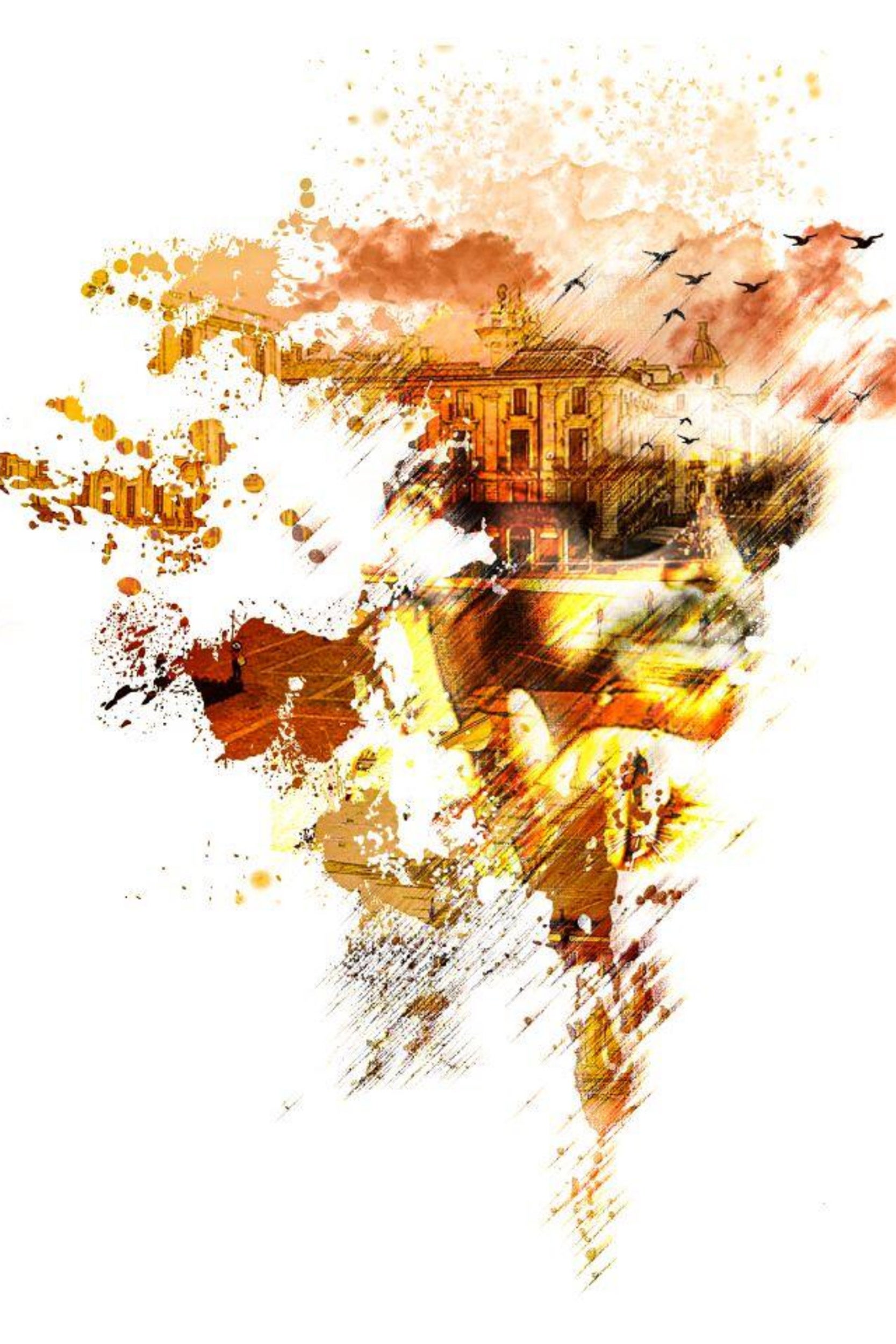
Vincent Liu
Security Officer, Securitas / Digital Art & Blitheness
Four years agone, right after earning his primary's in instruction, Liu took a trip to Italy, where he lost his passport. Stranded and homeless, he met a sometime fine fine art professor-turned-street artist, who taught him how to make spray paint art.
"I didn't do any sort of art earlier that," Liu said. Later, he could do zippo but. "I dropped my teaching career and started to pursue this new passion."
Liu started working for Securitas concluding March, right before nonessential staff left to piece of work from domicile. But Liu is essential. Sitting at the Smith Center security desk, he enjoys the placidity — information technology gives him downtime in which to draw. Though he started out sketching portraits (during the virtual launch, he sat in front of a wall covered in mitt-fatigued portraits of characters from "Game of Thrones"), he quickly realized that he couldn't make coin from that genre solitary. This past autumn, he took a video-editing grade through the Harvard Extension School, and for ane assignment he had to breathing a logo. And and so he was hooked.
For the Staff Fine art Show, Liu submitted his terminal project for his video editing class, a two-minute animation called "Corona" that he described as "light-hearted … a distraction from the dismal mood of a precarious pandemic." In the piece, a stick effigy human walks through a pastoral scene until a looming cityscape rises backside it and a canteen of Corona beer explodes in his face. Chaos — including storm troopers, a swarm of bees, and more explosive Corona bombs — ensues. At the end, a message appears: "Stay condom. Stay healthy. Stay home."
Liu also volunteered to create a trailer for the show, which animated more than than 100 pieces of artwork. Merely he submitted a less light-hearted slice, too. Titled "Jehangir," which means "king of the globe," the digital piece of work is a tribute to a co-worker's dad who recently passed away from COVID-xix.
Liu wants to become a full-time animator. But no matter where he ends up, Liu said he wants to do something creative, "something that allows me to proceed on progressing every bit a person and as an creative person."
Susan Kinsella
Assistant to the Chair, Department of Chemical science and Chemical Biology / Collage
Five minutes before midnight on the concluding day to submit work for the Harvard Staff Fine art Bear witness, Susan Kinsella sat in front of her reckoner. She nonetheless hadn't submitted her piece of work. She poured a drinking glass of wine.
When she was young, Kinsella had loved to describe — mostly horses — and spent Sundays perched on the floor in front end of the TV watching Jon Gnagy's "Learn to Depict." Only her friend Toots Zynsky was also artistic, and every bit they grew Kinsella saw Zynsky eclipse her. Zynsky is now a professional person drinking glass artist with pieces worth hundreds of thousands of dollars in museums across the world.
"So, I wasn't an artist," Kinsella said. "Toots was an artist."
Still, Kinsella was a maker: She sewed her own clothes, crocheted, and designed holiday cards. She worked for decades to draw the perfect cup of tea with steam rising off it ("I succeeded by 1972"). She wrote poetry, too, but when her kids were young, "Life got hard," and she stopped. It wasn't until they grew up and she moved to Somerville that she thought, "OK, I'll start writing again." Only she didn't; for some reason, her heart wasn't in it anymore.
A gift certificate from a friend to Bead Works in Cambridge started her jewelry-making. To her surprise, people bought her designs. She ended up at Snow Farm, a residential craft school in Williamsburg, Mass., where she took metalworking to expand her jewelry skills until she heard an artist requite a talk nearly collage: "This was art," Kinsella said. "This wasn't simply drawing a steaming tea loving cup."
That was v years ago. The same collage artist who gave the inspirational talk, who is now Kinsella's teacher, recently met with her for a socially-distant chat about her artistic progress. As she looked over Kinsella's recent work, she said, "You take a evidence here."
"I started calling myself an artist 3 years ago," said Kinsella. That admission felt powerful, but it doesn't mean any step comes without dubiousness: At five minutes to midnight, Kinsella took a sip of wine, uploaded her two collages, and hitting submit.
Roel Torres
Laboratory Administrator, Department of Chemical science and Chemical Biological science / Digital Illustration
When Roel Torres was a child growing upwards in the Philippines, a comic book was a luxury, a treat his mother would buy him every now then. Torres was still a kid when he and his mother moved to the U.S., and so she encouraged his love of comic books, which were cheaper and more plentiful in usa. But shortly Torres realized something: He could make his ain.
Twenty of Torres' 24 comic volume projects have been published in the last four years. His stories take epic titles similar "Rogue Agent Zed," "Gladiasaurs," and "Deathface Rocket Crew." Recently, he contributed to a collection of graphic stories chosen BORDERx designed to spotlight the border crisis. Torres' submission depicts heroes fighting racists. The project donates all gain to nonprofits that help border immigrants, such as the S Texas Human Rights Center.
Merely Torres didn't submit whatever of his comic book artwork to the Harvard Staff Art Show; that, he said, works all-time aslope a narrative. Instead, he submitted two of the hundreds of effigy drawings he generated in his 3-60 minutes-a-week, Cambridge-based figure cartoon group. "The entire reason I do figure cartoon is to exist a more effective, more efficient, more proficient comic volume creator," Torres said.
A self-described extrovert, Torres has always craved connectedness and interaction. When he started making comic books he did so in isolation, but he found it lonely and desolate. "It was simply when I constitute a community of like-minded individuals that I really found a joy in it." For him, the staff art show was some other opportunity to create customs around fine art. As a break-out room host in the evidence's virtual launch, he met Claudette Agustin, a beau Pinoy and someone he never may have encountered otherwise.
"Fifty-fifty during a fourth dimension when we're all isolated and working at home remotely, fine art goes on and art remains of import in people's lives," Torres said. "Iv hundred people volition gather to celebrate fine art and view fine art and the making of it."
@HarvardStaffArtShow: https://www.instagram.com/harvardstaffartshow/
Visit the gallery: https://projects.iq.harvard.edu/staffartshow/gallery
The Daily Gazette
Sign up for daily emails to get the latest Harvard news.
Source: https://news.harvard.edu/gazette/story/2021/03/first-harvard-staff-art-show-celebrates-employees-whole-selves/

Post a Comment for "Harvard Hit Us Up They Said Come to Art School"